Bioconjugate Delivery Systems — Where ADC Meets LNP and Beyond — ADC & LNP

ADC (antibody–drug conjugates) and LNP (lipid nanoparticles) are our core platforms. We design, build, and QC the complete delivery system — from linker selection and cysteine re‑bridging to ionizable lipids, PEGylation, and ligand targeting.

ISO 9001:2015 / ISO 13485:2016
45+ Years
Bench → Kilo Scale
Texas, USA
Confidential & IP‑Protectedd

Overview

At Bio-Synthesis, we craft carrier delivery systems that pair the right carrier with the right linker and payload. Our two flagship platforms are Antibody–Drug Conjugates (ADC) for targeted small‑molecule delivery and Lipid Nanoparticles (LNP) for nucleic‑acid and protein cargoes. Each build is engineered for stability, selectivity, and the desired release profile, then verified with UV–Vis/DAR, LC‑MS, and SEC‑HPLC.

Bioconjugate delivery covers both covalent and non-covalent strategies for transporting therapeutic payloads. Our platform integrates three major carrier classes:

  • Covalent bioconjugates such as ADCs, where small-molecule drugs are chemically linked to antibodies for highly selective targeting.
  • Encapsulated systems such as Lipid Nanoparticles (LNPs), which package nucleic acids or proteins within ionizable lipid structures for potent intracellular delivery.
  • Hybrid carriers including polymeric nanoparticles, albumin/ferritin carriers, and peptide-based systems for controlled release, improved PK/PD, and tissue-specific uptake.

Together, these delivery modes allow us to engineer bioconjugates that match the biology of your payload — whether you require durable release, endosomal escape, receptor-mediated uptake, or immune-silent systemic circulation.

Targeted (ADC)

Cys‑selective labeling, re‑bridging chemistries, cleavable/non‑cleavable linkers, defined DAR, and site‑specific options.

Encapsulated (LNP)

Ionizable lipids + helper lipids (cholesterol, DSPC, PEG‑lipid), DOE‑driven N/P optimization, and ligand decoration.

Analytics

DAR/DoL, particle size/PDI, encapsulation %, residuals (solvent/copper), and stability testing under relevant matrices.

ADC Platform — Antibody–Drug Conjugates

Antibody / Fragment
Linker (cleavable / non-cleavable)
Payload (toxin / probe)
Product Highlights
  • Cys targeting via maleimide/iodoacetyl; re‑bridging (dibromomaleimide, bis‑sulfone, pyridazinedione).
  • Cleavable linkers: disulfide, hydrazone, dipeptide/self‑immolative; non‑cleavable for durability.
  • PEG spacers to tune hydrophilicity, reduce aggregation, and optimize PK.
  • Orthogonal click pairs (SPAAC/iEDDA) for two‑step installs and dual‑payload concepts.

We target defined DAR with minimal aggregation and provide full QC packages suitable for IND‑enabling studies.

Preferred Applications
  • ADC prototypes and payload screening (toxins, immunomodulators, fluorophores).
  • Site‑specific antibody conjugation (engineered Cys, glycan‑to‑aldehyde, enzymatic tags).
  • Stability & release profiling across serum‑like matrices and reductive environments.

Setup & Conditions
  • Maintain pH ~6.5–7.2 for maleimide steps.
  • Remove excess TCEP before coupling to avoid over‑reduction.
  • Cys re‑bridging options: dibromomaleimide, bis‑sulfone, pyridazinedione.
  • Compare cleavable (disulfide/hydrazone/dipeptide) vs non‑cleavable in parallel.
QC Checkpoints
  • DAR by UV–Vis and/or intact MS; confirm distribution.
  • Aggregation by SEC‑HPLC; purity by CE‑SDS (non‑reducing).
  • Residual reagents (e.g., solvent/copper) below spec.
  • Stress/stability: serum‑like matrices; reductive challenge.

Antibody
Sequence/lot, expected interchain disulfides, buffer composition.
Target DAR
2, 4, or 8; acceptable range; aggregation threshold.
Linker
Cleavable vs non‑cleavable preference; PEG length.

LNP as Non-Covalent Bioconjugate Vehicles

While ADCs represent covalent bioconjugation, LNPs serve as the premier non-covalent bioconjugate carrier for RNA, DNA, siRNA, saRNA, and protein cargos. By replacing chemical linker–drug architectures with lipid–cargo assembly, LNPs deliver fragile payloads through encapsulation, ionizable lipid charge switching, and optimized helper lipid ratios.

Ionizable Lipid + Helpers
Cholesterol · DSPC · PEG‑lipid
Encapsulation / N:P
mRNA / saRNA / siRNA / Protein
Product Highlights
  • Ionizable lipid screening and DOE to optimize N:P, size, and encapsulation %.
  • Helper lipids (cholesterol/DSPC/PEG‑lipid) ratio tuning for stability and delivery.
  • Ligand decoration (antibody/peptide/small‑molecule) for targeted uptake.
  • Analytics: size/PDI (DLS), zeta potential, encapsulation %, potency readouts.
Preferred Applications
  • mRNA vaccines and gene‑silencing (siRNA/ASO) formulations.
  • Protein or CRISPR RNP delivery requiring transient cytosolic exposure.
  • Organ‑ or cell‑type targeting via surface ligands and PEG engineering.

Formulation Controls
  • Optimize N:P via DOE; track size/PDI and encapsulation %.
  • Control mixing energy and pH during microfluidic or bulk mixing.
  • Tune helper lipid ratios (cholesterol/DSPC/PEG‑lipid).
  • Verify ethanol residuals; finalize buffer exchange.
QC Checkpoints
  • Size/PDI by DLS; zeta potential per spec.
  • Encapsulation % and potency readouts.
  • Stability: accelerated + real‑time under target storage conditions.
  • Targeting: confirm ligand density/PEG chain length.
LNP Composition
  • Ionizable lipids — enable endosomal escape.
  • Structural lipids (e.g., DSPC) — stabilize the lipid bilayer.
  • Cholesterol — improves membrane integrity.
  • PEG‑lipids — enhance circulation time and stability.
Manufacturing Process
  • Microfluidic mixing for reproducible, scalable assembly.
  • Uniform particle size distribution (typ. 60–150 nm).
  • High encapsulation efficiency (often >90% when applicable).
  • Custom payload loading: mRNA, siRNA, DNA, proteins.

Lipid Nanoparticles Encapsulation Project
  • LNP formulation: ONPATTRO (patisiran)
  • Lipid components: Dlin-MC3-DMA, DSPC, cholesterol, DMG-PEG 2000
  • Lipid ratio: 50 : 10 : 38.5 : 1.5
  • Flow rate ratio (Aqueous : Organic): 3 : 1
  • N/P ratio: 3
DLS profile of LNP-siRNA at 12 ml/min flowrate
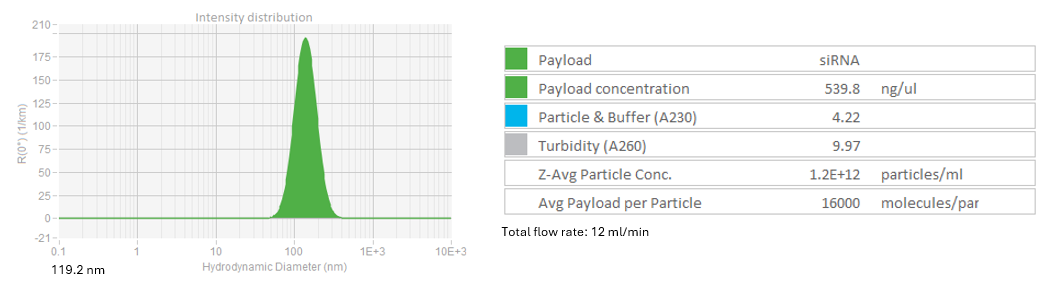

LNP-siRNA3: Initial RNA concentration 1.1 mg/ml

DLS profile of LNP-siRNA after 5 day storage at 4C
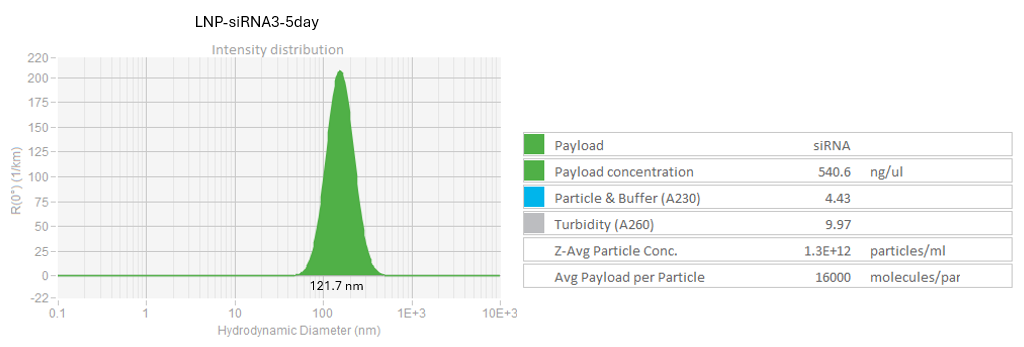
DLS profile of LNP-siRNA at 12 ml/min flowrate
Testing dilution method
DLS profile of LNP-siRNA at 12 ml/min flowrate

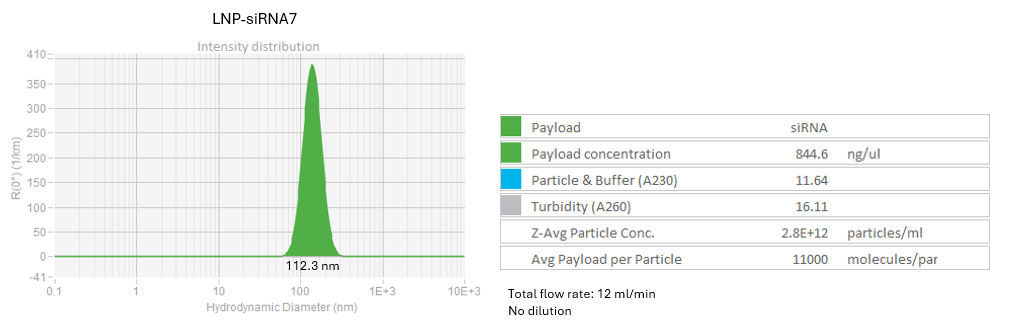
LNP-siRNA7, LNP-siRNA8: Initial RNA concentration 1.1 mg/ml

Dilute the LNP-siRNA using dilution buffer within Sunshine chip
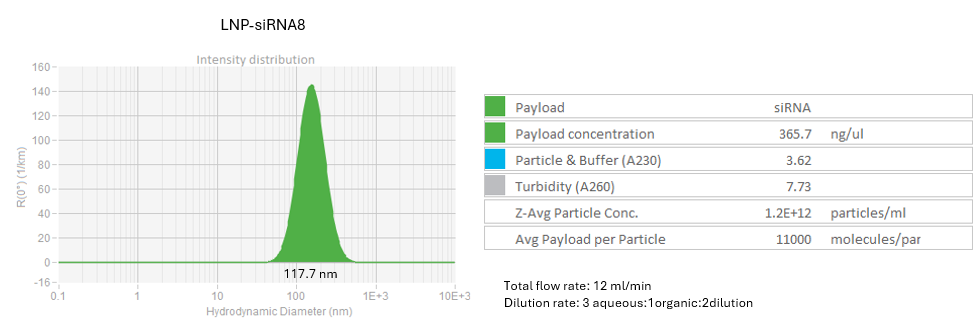
DLS profile of LNP-siRNA at 12 ml/min flowrate
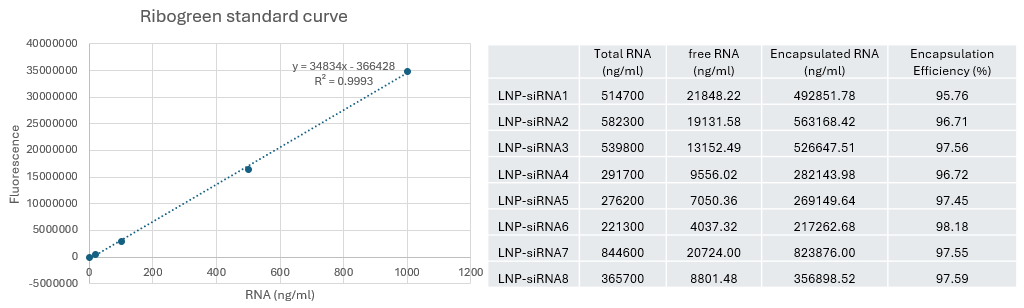
Encapsulation efficiency of several LNP-siRNAs we have tested in lab
DLS profile of LNP-siRNA at 12 ml/min flowrate
Conclustion
  • Flow rate at 12 ml/min is good to generate the LNP-siRNA with desirable size, ~120 nm
  • Final concentration of LNP-siRNA is ~ 0.5 mg/ml when encapsulation siRNA solution at 1.1 mg/ml, with aqueous : organic solvent 3:1 ratio
  • LNP-siRNAs are stable at 4C for >5 days (still counting…)
  • Encapsulation efficiency is very high at different flow rate when using Sunshine

Data demonstrating the use of Sunshine formulation parameters to produce high-encapsulation, uniform LNP–siRNA particles with optimized N:P ratios, low PDI, and strong gene-silencing performance.

You can insert full figures, tables, or captions here when ready.

Cargo
Sequence/size; chemical modifications; desired potency readout.
Lipid set
Ionizable lipid candidates; helper lipid preferences.
Specs
Target size/PDI, encapsulation %, ligand plan (if applicable).

Bioconjugate Delivery Comparison

Platform Conjugation Type Typical Cargo Key Strength
ADC Covalent (linker-drug) Small molecules Precise tumor targeting
LNP Non-covalent (encapsulation) mRNA · siRNA · saRNA · Protein Potent intracellular delivery
Polymeric Covalent or encapsulated Hydrophobic drugs · Oligos Controlled release kinetics
Protein/Peptide Covalent or ligand-receptor Proteins · CPP-cargo Receptor-mediated targeting

Other Carrier Platforms

Polymer Carrier
PLGA · PEG · Dendrimers
Linker / Spacer
Payload
Small molecules / Oligos
Polymeric Carriers
  • Materials: PLGA nanoparticles, PEGylated micelles, dendrimers, polysaccharides.
  • Release control: hydrolysis-tuned PLGA, pH/redox-cleavable spacers.
  • Surface engineering: PEG density, ligand conjugation (antibody/peptide/small molecule).
Preferred Applications
  • Controlled release of hydrophobic drugs and imaging probes.
  • Combination payloads and co-encapsulation studies.
  • Depot or targeted delivery with ligand/PEG tuning.
Protein / Peptide Carrier
Albumin · Ferritin · CPPs
Linker (cleavable / non‑cleavable)
Payload
Toxins · Oligos · Proteins
Protein/Peptide Systems
  • Albumin/ferritin carriers for long-circulation and receptor-mediated uptake.
  • Cell-penetrating peptides (CPPs) and targeting peptides for intracellular delivery.
  • Enzymatic/site-selective conjugation options; glycan-to-aldehyde strategies.
Preferred Applications
  • Targeted payload delivery with endogenous carrier pathways.
  • Intracellular delivery of oligos, proteins, or probes using CPPs.
  • Multivalent displays and bispecific ligand concepts.

Technical Summary

Workflow
  • Intake: route selection and risk register
  • Scout: stoichiometry & pH/time screens (ADC); N:P DOE (LNP)
  • Build: conjugation/encapsulation with chosen spacer/ratios
  • Polish: desalting/SEC (ADC); buffer exchange/solvent removal (LNP)
  • QC: UV–Vis/DAR, LC‑MS, SEC‑HPLC; size/PDI, zeta, encapsulation %
Controls & Comparators
  • Cleavable vs non‑cleavable linkers; spacer length laddering
  • Alternative ionizable lipids and PEG‑lipid densities
  • Orthogonal readouts (potency, stability, aggregation)
Documentation
  • Method summaries and batch records
  • Certificate of Analysis with acceptance criteria
  • Optional tech transfer package

FAQ

ADC: cleavable vs non‑cleavable — how to choose?

Use cleavable (disulfide, hydrazone, dipeptide/self‑immolative) when intracellular release is needed; choose non‑cleavable when maximal durability is required.

How do you control DAR and aggregation?

We combine stoichiometry control, Cys engineering/re‑bridging, PEGylation, and SEC‑based polishing; DAR is quantified by UV–Vis/MS, aggregation by SEC‑HPLC/CE‑SDS.

LNP: what affects size and encapsulation %?

Ionizable lipid structure, helper lipid ratios, N:P, mixing energy, and pH all impact size/PDI and encapsulation. We optimize by DOE.

Can you add targeting ligands to LNP?

Yes. We decorate LNP with antibodies, peptides, or small molecules; PEG chain length and density are tuned to balance stealth vs targeting.

Do you offer copper‑free click options?

Yes — SPAAC (DBCO/BCN) and iEDDA (tetrazine↔TCO) are available for copper‑sensitive systems and dual‑payload strategies.

What to include in sample submission?

Provide antibody/cargo details, desired DAR or N:P window, linker/PEG preferences, buffers, and QC specs (size/PDI, zeta, encapsulation %, stability).

Contact

Talk to Our Carrier Delivery Team

Share your ADC or LNP goals, linker/lipid preferences, payload/cargo, and QC needs. We’ll scope the route and return a quote with
recommended controls and analytics.

Request a Quote Feasibility Check NDA / MSA Sample Submission
Phone: +1-972-420-8505
Full Name *
Email *
Company / Institution *
Phone *
Project type *
Sample type
Project phase
Message
Attach file (optional)

By submitting, you agree to be contacted regarding your request.

Recommended Reading

  1. Chari, R. V. J. et al. (2014). Antibody–drug conjugates: An emerging concept in cancer therapy. Cancer J. — ADC fundamentals, payloads, and linkers.
  2. Barenholz, Y. (2012). Doxil — The first FDA-approved nano‑drug: Lessons learned. J. Controlled Release — Liposomal/LNP design insights.
  3. Hou, X. et al. (2021). Lipid nanoparticles for mRNA delivery. Nat. Rev. Mater. — Ionizable lipids, helper ratios, and N:P optimization.
  4. Pasut, G. & Veronese, F. M. (2012). PEGylation for improving the effectiveness of therapeutic biomolecules. J. Controlled Release — PEG density/length and PK effects.
  5. Chudasama, V. et al. (2016). Next‑generation maleimides for stable cysteine bioconjugation. Chem. Sci. — Stabilized thioether strategies for ADCs.
  6. Uchida, M. & Kostiainen, M. A. (2020). Protein cages as delivery platforms. ACS Nano — Ferritin/viral‑like protein carriers.
  7. Desai, N. (2012). Polymeric nanoparticle delivery systems for cancer therapy. Transl. Oncol. — PLGA, micelles, dendrimers; release control.
  8. Devaraj, N. K. (2018). The future of bioorthogonal chemistry. ACS Cent. Sci. — SPAAC vs iEDDA for conjugation campaigns.
  9. Hermanson, G. T. (2013). Bioconjugate Techniques, 3rd Ed. Academic Press — Reference for NHS, maleimide, SPDP, EDC, and analytics.
  10. Schlake, T. et al. (2019). Developing mRNA‑vaccine technologies. Mol. Ther. — LNP process & quality considerations.

Why Choose Bio-Synthesis

Trusted by biotech leaders worldwide for over 40+ years of delivering high quality, fast and scalable synthetic biology solutions.