Multivalent Peptide Synthesis

Functional multivalent peptide constructs designed to enhance avidity, clustering, and assay performance.

Overview

Multivalent peptides: what they are (and what they are not)

Bio-Synthesis provides custom multivalent peptide synthesis as a dedicated service, supporting research programs that require controlled epitope density, enhanced avidity, or receptor clustering beyond what linear peptides can achieve. With over 45 years of peptide manufacturing experience, our team designs and synthesizes multivalent constructs using MAP peptides (MAP-2/4/8), lysine- and diamino-acid branching, dendrimeric cores, and modular click-assembled architectures—selected based on spacing, steric constraints, solubility, and downstream application requirements.

Unlike catalog-driven offerings, our multivalent peptide service emphasizes design review, synthesis feasibility, purification planning, and fit-for-purpose QC. We work closely with customers to control branch-point fidelity, minimize mixed-arm products, and deliver constructs suitable for immunology, receptor clustering, diagnostic assays, and discovery workflows, with analytical documentation aligned to screening or assay-grade needs.

Each project is reviewed by experienced peptide chemists to ensure the selected multivalent strategy is practical to synthesize, analytically interpretable, and aligned with experimental goals—not just theoretically multivalent.

Branch peptide Dendrimeric cores Strategy-fit-for-purpose ISO 9001:2015/ISO13485:2016 45+ Years of Expertise U.S. Facilities - Texas
Higher avidity

Multiple motifs can increase functional binding strength through multivalent interactions.

Receptor clustering

Multivalency can drive clustering/engagement when mono-valent ligands underperform.

Signal amplification

More binding events per molecule can improve capture/detection assays (design-dependent).
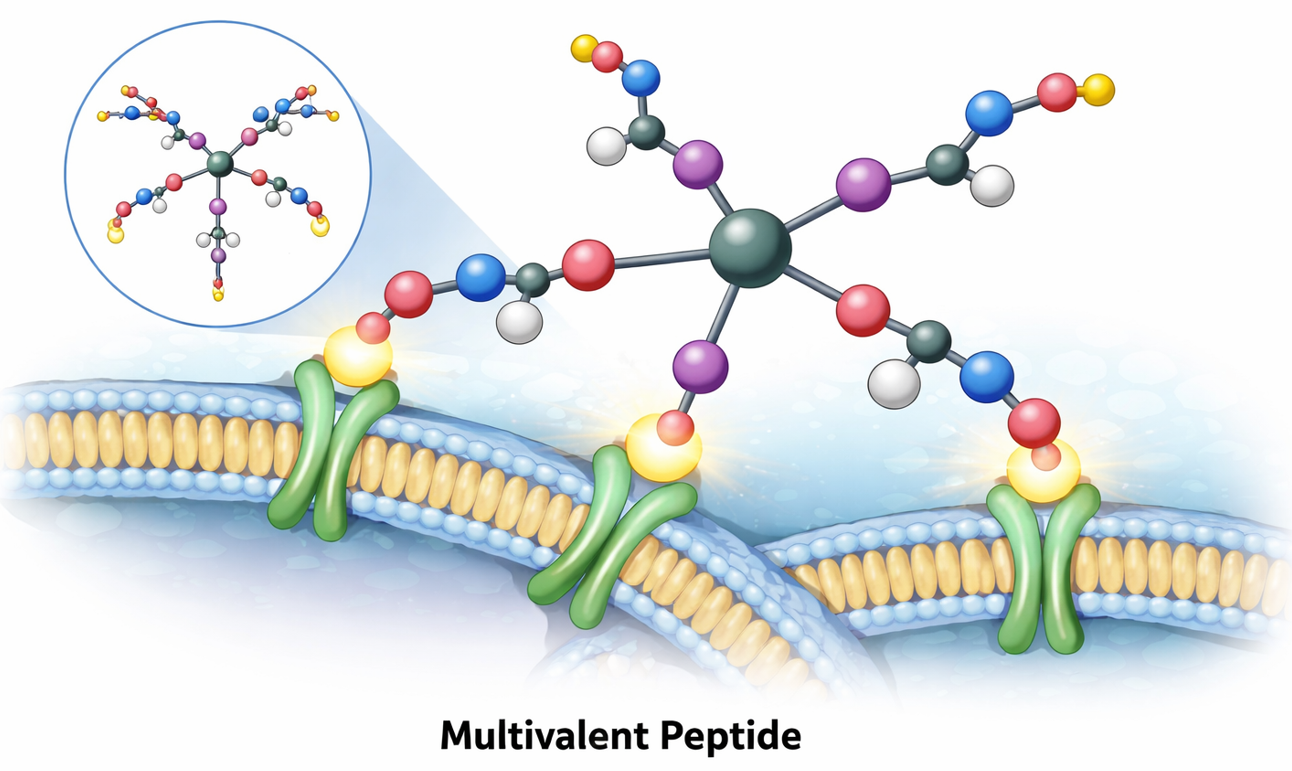
Multivalent peptide synthesis strategies including MAP or lysine-branched peptides, dendrimeric cores, and click-assembled modular multivalent constructs.
Figure: Common multivalent peptide architectures—MAP/branched formats, dendrimeric cores, and click-assembled modular designs.
Multivalent peptide synthesis MAP peptide synthesis Branched peptides Dendrimeric peptides Click chemistry peptides Hetero-branched peptides

Related services: Custom Peptide Synthesis, Peptide Modifications, Peptide Bioconjugation, Click Chemistry Peptides. For ready-made options, browse Catalog Peptides.

Common requests: MAP-2/4/8 peptide synthesis, multivalent epitope constructs, receptor-clustering ligands, and modular click-assembled multivalent probes (project-dependent).

Capabilities at a glance

Architectures
  • Lysine-branched (Y / star)
  • MAP-2 / MAP-4 / MAP-8
  • Dendrimeric & multivalent (project-dependent)
Options
  • Biotin, fluorophores, PEG/spacers
  • Click handles (azide/alkyne), cleavable linkers
  • Isotope labels (project-dependent)
Deliverables
  • MS identity confirmation
  • HPLC profile / purity (where feasible)
  • COA + supporting documentation

Need help choosing a branching strategy? Send your sequence(s), copy number/valency target, and downstream use—we’ll recommend a practical synthesis, purification, and QC plan.

Multivalent peptide design strategies

MAP & lysine-branched formats

Fast path for epitope density and common immunology workflows. Suitable for homo-branched designs and MAP copy-number control.

  • MAP-2 / MAP-4 / MAP-8
  • Y-shaped and star-like branching
  • Orthogonal protection to reduce mixed products
Diamino acids (Dap/Dab/Orn)

Alternative branch points to tune spacing and reduce steric congestion compared with lysine.

  • Geometry/spacing control
  • Useful for difficult or hydrophobic arms
  • Project-dependent feasibility
Dendrimeric cores

Higher valency for receptor clustering, multivalent binding, and probe/material designs (project-dependent).

  • Generation-defined valency
  • Strong avidity potential
  • Purification/analytics planning is critical
Click-assembled multivalency

Modular assembly after SPPS using azide/alkyne handles for peptide–peptide and hybrid constructs.

  • CuAAC / SPAAC options
  • Orthogonal to SPPS
  • Best when modularity matters
Cysteine / thioether branching

Post-synthetic branching using cysteine chemistry for modular or stimulus-responsive designs (project-dependent).

  • Thioether or disulfide formats
  • Useful for reversible assemblies
  • Handle placement matters
Small-molecule scaffold cores

Rigid cores to control arm angle/geometry for multivalent ligands and SAR studies (project-dependent).

  • Defined geometry
  • Hybrid peptide–small molecule designs
  • Requires chemistry planning
Multivalent peptide synthesis MAP peptide synthesis Dap/Dab/Orn branching Dendrimeric peptides Click chemistry assembly Receptor clustering

Not sure which approach fits? Send your sequence(s), desired valency/copy number, and downstream use—we’ll recommend a practical multivalent strategy and QC plan.

Comparison table: multivalent strategies at a glance

Use this table to select a multivalent approach based on geometry, steric congestion risk, modularity needs, and purification/QC considerations.

Strategy Best for Strengths Watch-outs Typical choices
Lysine MAP / Lys-branch Epitope density, immunogens, common multivalent screening constructs Established SPPS; clear copy-number options; efficient for homo-branched designs Steric crowding at high valency; aggregation risk; mixed products if not controlled MAP-2 / MAP-4 / MAP-8; Y-shaped; star-like
Diamino acids (Dap/Dab/Orn) When lysine spacing/geometry is suboptimal or yield/purity limits appear Tunable spacing; can reduce crowding vs lysine; helpful for difficult arms Project-dependent feasibility; requires more design input Dap, Dab, Orn branch cores
Dendrimeric cores Higher-valency clustering, receptor clustering, probe/material designs Generation-defined valency; strong avidity potential; flexible designs (case-dependent) Purification and analytics are more complex; solubility management required Generation-style dendrimers; custom scaffolds
Click-assembled multivalency Modular assembly, hybrid constructs, multivalent libraries Orthogonal to SPPS; flexible assembly order; scalable modular design Requires compatible handles and downstream chemistry plan Azide/alkyne (CuAAC/SPAAC), modular ligation

Practical tip: for multivalent constructs, “purity %” alone can be misleading—ask how your provider manages branch-point fidelity, arm-to-arm uniformity, and analytical interpretability.

Why multivalent peptides fail (and how to prevent it)

Multivalent peptides often fail due to physical effects that don’t impact linear peptides. The most common failure modes are:

Steric congestion & incomplete coupling
  • Crowding near branch points reduces coupling efficiency
  • Higher valency increases risk of mixed-arm products
  • Orthogonal protection + optimized cycles are required
Aggregation, solubility & purification complexity
  • High local density promotes on-resin aggregation
  • Multivalent constructs broaden chromatographic peaks
  • Spacer/PEG decisions affect solubility and assay behavior

Our planning focuses on geometry/spacing, aggregation control, and purification + QC interpretability so you receive a construct that behaves as intended.

Synthesis workflow

1) Design review

Confirm branch architecture, protection strategy, arm order (hetero-branch), and success criteria.

2) SPPS assembly

Build arms using orthogonal deprotection and optimized coupling cycles near branch-point congestion.

3) Purify & validate

Purify with a plan aligned to hydrophobicity/charge and verify identity with fit-for-purpose analytics.

What we optimize (practically)
  • Orthogonal protecting groups for clean arm growth
  • Coupling completeness at sterically hindered sites
  • Aggregation control to maintain resin mobility
  • Purification strategy matched to construct complexity
  • Analytical plan to confirm architecture and identity
  • Documentation aligned to screening vs assay-grade needs

Specifications: what to define for a fast quote

Core specs
  • Sequence(s) for each arm (and whether arms are identical)
  • Architecture: lysine-branched, MAP-2/4/8, dendrimeric (or ask us to recommend)
  • Required modifications/handles (biotin, dyes, azide/alkyne, cysteine, linkers)
  • Quantity (mg) and intended application (immunization vs assay vs binding)
  • Purification/QC needs (desalt vs HPLC; MS; HPLC report)
Fastest quote checklist
  • One construct per line (or attach a spreadsheet)
  • State “screening” vs “assay-grade”
  • Note solubility constraints (buffer / co-solvent limits) if known
  • Indicate required purity threshold (if strict)
  • Provide timeline and shipping requirements

Branched peptide deliverables are sequence- and architecture-dependent. We recommend fit-for-purpose purity/QC targets and a purification plan aligned to your application.

Parameter Typical options Notes / guidance
Architecture Lysine-branched (Y/star); MAP-2/4/8; dendrimeric Hetero-branch constructs may require deeper characterization.
Branch points Single or multiple Strategy depends on orthogonal protecting groups and arm order.
Arm length Project-dependent Long or hydrophobic arms may require aggregation control or staged approaches.
Purification Desalted or HPLC purified (where feasible) High valency can increase hydrophobicity and broaden peaks; we plan accordingly.
QC MS identity, HPLC profile/purity (when applicable) Additional analyses recommended for complex hetero-branch constructs as needed.
Options Labels, click handles, PEG/spacers, isotope labels Specify handle location and downstream chemistry.
Quantity 1–10 mg typical (more upon request) Yield depends on sequence risk, valency, and purification level.

QC & deliverables

Standard analytics
  • Mass spectrometry identity confirmation (MALDI-TOF or ESI-MS)
  • HPLC profile / purity assessment (where feasible)
  • Certificate of Analysis (COA)

For high-valency or hydrophobic constructs, we align analytical conditions to solubility and chromatographic behavior.

Fit-for-purpose guidance
  • Immunogens/MAP: prioritize architecture fidelity and consistent epitope presentation
  • Assay-grade: prioritize purity and analytical clarity
  • Screening: prioritize throughput and identity confirmation

For conjugation-ready constructs, see Peptide Bioconjugation.

How to compare multivalent peptide synthesis providers

Many multivalent peptide pages on the market focus on keywords like “MAP peptide synthesis” but skip the details that actually determine whether you receive the intended architecture (and whether it will behave in your assay). Use the checklist below when evaluating providers—including large catalog-style suppliers and specialty peptide labs.

Questions that predict success
  • How do you prevent mixed-arm products in hetero-branched designs?
  • What orthogonal protecting group strategy do you use at the branch point?
  • How do you manage aggregation / steric congestion for MAP-8 or high-valency constructs?
  • Will you recommend spacers/PEG/linkers to improve presentation and solubility?
  • What is your plan for purification when peaks broaden for multivalent constructs?
QC that matters for branched peptides
  • MS identity aligned to architecture complexity (not only linear mass)
  • HPLC profile/purity where feasible, with conditions compatible with your solubility constraints
  • Clear COA + documentation level: screening vs assay-grade
  • Option to add handles and confirm labeling readiness
  • Consistency approach for repeat orders / scale-up

Our approach emphasizes branch-point control, practical purification planning, and fit-for-purpose analytics so you receive a construct that matches the intended multivalent design.

Applications

Immunology & vaccines

MAP and multivalent epitopes to increase epitope density for immune studies and antibody generation (design-dependent).

Receptor clustering

Multivalent ligands to drive clustering/avidity when mono-valent peptides underperform.

Diagnostics & assays

Improved capture/detection signal using controlled multivalent presentation and handles for immobilization.

Drug discovery & SAR

Defined geometry scaffolds and modular click-assembled constructs for structure–activity exploration (project-dependent).

Probe development

Multivalent probes with biotin/fluorophores/click handles to support target engagement studies.

Biomaterials

Higher-valency assemblies for materials/self-assembly research (project-dependent).

Also explore: Peptide Libraries and Peptide Arrays.

FAQ

Can you add labels or functional handles?

Yes—biotin, fluorophores, PEG/spacers, click handles (azide/alkyne), and cleavable linkers are available when compatible with your design and chemistry plan.

What is multivalent peptide synthesis?

Multivalent peptide synthesis produces a construct that presents multiple copies of an epitope or multiple binding motifs in one molecule to increase avidity, enable receptor clustering, or amplify assay signal. Multivalency can be achieved through MAP/branched formats, dendrimeric cores, or modular click-assembly.

Is a MAP peptide the same as a multivalent peptide?

MAP peptides are a common subset of multivalent peptides (often MAP-2/4/8 on lysine-based cores). Multivalent peptides also include dendrimeric constructs, diamino-acid branching, click-assembled modular multivalency, and hybrid scaffold designs.

How do I choose MAP vs dendrimer vs click assembly?

Choose based on spacing/geometry, steric congestion risk, and whether you need modularity. MAP/lysine-branch is often the fastest for epitope density. Dendrimeric cores suit higher-valency clustering (project-dependent). Click assembly is ideal for modular libraries or hybrid designs.

Why do multivalent peptides have lower yield or broader HPLC peaks?

Higher valency increases steric crowding and aggregation risk, which can reduce coupling efficiency and complicate purification. Multivalent constructs often produce broader chromatographic features; spacer/PEG choices and purification planning are key.

What QC is recommended for multivalent peptides?

Most projects use MS identity and HPLC profile/purity where feasible. For higher-valency or modular constructs, we recommend a fit-for-purpose analytical plan to ensure interpretability and alignment with your application.

CONTACT US

Speak to a Peptide Scientist

Share your sequence(s), target architecture (lysine-branched, MAP-2/4/8, or “recommend”), any modifications/handles, quantity, and intended application. We’ll propose practical specifications and a synthesis/purification/QC plan aligned to your goals.

Tip: For MAP designs, specify epitope copy number (2/4/8), spacing/linker preferences, and whether you want carrier-free presentation.

Why Choose Bio-Synthesis

Trusted by biotech leaders worldwide for over 40+ years of delivering high quality, fast and scalable synthetic biology solutions.