Recombinant Protein–Oligonucleotide Conjugation Services

Custom DNA, RNA, siRNA, ASO, SSO, PNA, and PMO protein conjugates with site-specific chemistry, linker engineering, purification, and fit-for-purpose QC.

Custom protein–oligonucleotide conjugation services for targeted delivery, molecular diagnostics, assay development, imaging, and advanced research applications.

Overview

Recombinant protein–oligonucleotide conjugates combine the target recognition, binding specificity, or biological activity of a recombinant protein with the programmable, sequence-defined function of a synthetic oligonucleotide. These hybrid constructs are used in targeted delivery, assay development, molecular imaging, proximity-based detection, and platform research where controlled architecture is essential.

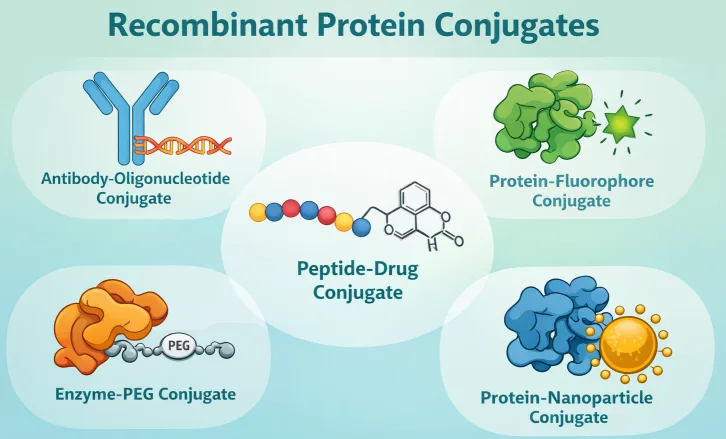
Depending on design goals, the protein component may function as an antibody, antibody fragment, nanobody, ligand, receptor-binding domain, enzyme, cytokine, or engineered scaffold, while the oligonucleotide can serve as a therapeutic cargo, barcode, capture handle, hybridization probe, regulatory sequence, or molecular recognition element.

Bio-Synthesis supports conjugation of single-stranded and duplex oligonucleotides including DNA, RNA, siRNA, ASO, SSO, PNA, and PMO to diverse recombinant protein formats using amine-reactive, thiol-reactive, click, and project-specific site-directed strategies with purification and fit-for-purpose analytical characterization.
Representative recombinant protein–oligonucleotide conjugate architecture showing a recombinant protein scaffold connected by a linker to a functional oligonucleotide cargo.
Representative recombinant protein–oligonucleotide conjugate architecture. Defined reactive handles and linker modules enable attachment of oligonucleotide cargo to recombinant proteins for targeting, delivery, detection, and assay applications.
protein oligo conjugates DNA / RNA / siRNA / ASO / SSO PNA / PMO conjugation site-specific chemistry cleavable or stable linkers fit-for-purpose QC
Key capability: Site-specific and application-driven oligonucleotide attachment to recombinant proteins using lysine, cysteine, click-compatible, or tag-enabled strategies with stoichiometry control, purification, and analytical confirmation.

Supported recombinant protein formats

Antibodies & antibody fragments
  • Monoclonal antibodies
  • Fab and scFv formats
  • Bispecific constructs
  • Engineered Fc-containing proteins
Engineered binding proteins
  • Nanobodies
  • Affibodies
  • DARPins
  • Custom affinity scaffolds
Functional protein formats
  • Enzymes
  • Cytokines
  • Growth factors
  • Receptor ligands and binding domains

Supported oligonucleotide cargo types

Oligonucleotide type Typical functional role Common conjugation format Typical considerations
DNA Hybridization handle, barcode, probe, capture strand Single-stranded or dual-functional constructs Spacer design and attachment site selection
RNA Functional RNA element, sensing sequence, delivery cargo Single-stranded or structured RNA formats Stability and handling conditions
siRNA RNAi cargo for targeted gene silencing Sense-strand or defined duplex conjugation Duplex architecture and strand selection
ASO / SSO Gene regulation, splice modulation, steric blocking Single-stranded therapeutic oligos with terminal handles Backbone chemistry and release strategy
PNA / PMO Neutral backbone recognition or steric-blocking applications Terminally modified conjugate formats Solubility, spacer choice, and construct format

Conjugation chemistry options

Chemistry Protein handle Oligo modification Key advantage Typical use
NHS ester coupling Lysine amines 5′ or 3′ amino-modified oligo Broad compatibility and straightforward setup General protein labeling and feasibility studies
Maleimide–thiol coupling Native or engineered cysteine 5′ or 3′ thiol-modified oligo Improved site control relative to lysine labeling Defined conjugates with lower heterogeneity
Click chemistry Azide or alkyne-bearing protein DBCO, azide, or alkyne oligo High-selectivity conjugation with minimal off-target reactivity High-selectivity conjugation for sensitive biomolecules
Tag-directed or enzymatic methods Engineered peptide or protein tags Compatible modified oligos Precise site-specificity and stoichiometry Advanced therapeutic and diagnostic construct design

Linker engineering options

Non-cleavable linkers

Used when the conjugate must remain intact through circulation, binding, assay execution, or immobilization.

  • Stable thioether linkages
  • PEG spacers for steric separation
  • Hydrophilic linker arms for solubility support
  • Permanent attachment for probe and assay constructs
Cleavable linkers

Useful when conditional release, intracellular liberation, or trigger-responsive activation is desired.

  • Disulfide linkers for reductive release
  • Enzyme-cleavable peptide linkers
  • Acid-labile or pH-sensitive linkers
  • Trigger-responsive linker systems selected based on application requirements

Design considerations

Protein-side considerations
  • Retention of protein binding or biological activity
  • Selection of accessible, non-disruptive reactive sites
  • Control of aggregation and formulation behavior
  • Preservation of folding and disulfide integrity
Oligo-side considerations
  • Choice of 5′ versus 3′ attachment
  • Need for spacer arms to reduce steric crowding
  • Backbone and sugar chemistry compatibility
  • Single-strand versus duplex architecture planning
Construct architecture
  • Protein-to-oligo loading ratio control
  • Stable versus releasable conjugation strategy
  • Assay, delivery, or targeting-specific design intent
  • Purification workflow and analytical confirmation plan
Planning tip: If you are unsure which chemistry or linker is best, share the protein format, oligonucleotide type, intended application, and whether release is required.

Workflow: from design to delivery

1) Scope & plan

Review protein format, oligo cargo, attachment site, linker needs, and application requirements.

2) Conjugate

Perform controlled conjugation using selected chemistry to support construct quality and reproducibility.

3) Purify & confirm

Purify the conjugate and perform fit-for-purpose analytical confirmation aligned to the project objective.

Fastest quoting tip: Share the recombinant protein format, oligonucleotide type or sequence, preferred attachment site if known, linker preference, quantity target, purity target, and intended application or assay format.

QC & deliverables

Purity assessment
  • HPLC or UPLC purity profile
  • SEC where appropriate for higher-order species
  • Gel-based assessment if useful for the construct type
Identity & structural confirmation
  • Mass spectrometry when feasible
  • UV-Vis characterization
  • Construct-specific analytical confirmation
Documentation
  • COA and method summary
  • Conjugate description and modification summary
  • Fit-for-purpose reporting aligned to intended use

Applications

Targeted therapeutic constructs
  • Antibody- or ligand-guided oligonucleotide delivery
  • Protein-enabled gene silencing or splice modulation systems
  • Multifunctional recombinant therapeutic architectures
Molecular diagnostics & assays
  • Protein–DNA probe systems
  • Signal amplification constructs
  • Barcode-enabled detection platforms
Research & platform development
  • Cell-targeting studies
  • Imaging and tracking constructs
  • Custom assay and hybrid tool development

FAQ

What oligonucleotide types can be conjugated to recombinant proteins?

DNA, RNA, siRNA, ASO, SSO, PNA, and PMO can be conjugated when compatible reactive handles and construct architecture are selected for the intended application.

Can protein–oligonucleotide conjugation be site-specific?

Yes. Site-specific conjugation can be achieved using engineered cysteine residues, click-compatible handles, and tag-directed or enzymatic approaches depending on the protein format and project goals.

Do you support cleavable linker designs?

Yes. Cleavable linker options such as disulfide, enzyme-responsive, and pH-sensitive systems can be incorporated when triggered release is desired.

What information is needed for a quote?

Share the recombinant protein format, oligonucleotide type or sequence, preferred attachment site if known, linker preference, quantity target, purity target, and intended application or assay format.

Contact & quote request

For the fastest quote on recombinant protein–oligonucleotide conjugation services, share the protein format, oligonucleotide type or sequence, preferred attachment site, linker preferences, quantity and purity targets, and intended application.

Fast quote checklist
  • Protein format and relevant construct details
  • Oligo type or sequence plus desired modification handle
  • Attachment site preference or request for recommendation
  • Linker preference, quantity target, purity target, and application
Fastest path

Recommended Reading & Literature References

The following references provide general background on bioconjugation methods and site-selective protein modification strategies.

  • Hermanson, G. T. Bioconjugate Techniques, 3rd ed.; Academic Press, 2013.
  • Hoyt, E. A.; Cal, P. M. S. D.; Oliveira, B. L.; Bernardes, G. J. L. Contemporary approaches to site-selective protein and peptide bioconjugation. Nat. Rev. Chem. 2019, 3, 147–171. DOI
  • Koniev, O.; Wagner, A. Developments and recent advancements in the field of endogenous amino acid selective bond forming reactions for bioconjugation. Chem. Soc. Rev. 2015, 44, 5495–5551. DOI
  • Agarwal, P.; Bertozzi, C. R. Site-specific antibody-drug conjugates: the nexus of bioorthogonal chemistry, protein engineering, and drug development. Bioconjug. Chem. 2015, 26(2), 176–192. DOI

Why Choose Bio-Synthesis

Trusted by biotech leaders worldwide for over 45+ years of delivering high quality, fast and scalable synthetic biology solutions.