Amino-Modified Oligonucleotides (5′, 3′ and Internal Amino-Linked DNA and RNA)

Custom DNA and RNA amino modifications for dye labeling, surface immobilization, and post-synthetic bioconjugation.

Amino-modified oligos with 5′, 3′, and internal amino linkers, aminoallyl nucleotides, amino-modified bases, aminooxy handles, PEG linkers, and specialized functional amino modifiers for research, diagnostics, and conjugation workflows.

5′ / 3′ / internal amino DNA & RNA compatible Linker and nucleobase options NHS dye conjugation ready Surface immobilization compatible

Overview

Amino-modified oligonucleotides are synthetic DNA or RNA molecules containing primary amine functional groups that enable covalent conjugation to dyes, ligands, surfaces, proteins, polymers, nanoparticles, and other functional materials. These amine handles are among the most versatile reactive groups used in post-synthetic oligo labeling and bioconjugation workflows.

Amino modifiers can be introduced at the 5′ terminus, 3′ terminus, or internal positions using terminal linker phosphoramidites, amino-functionalized nucleobases, aminoallyl nucleotides, PEG-based spacers, and specialized functional modifiers such as aminooxy or photocleavable amino linkers. These modifications support probe labeling, microarray immobilization, biosensor construction, antibody–oligo conjugates, nanoparticle attachment, and broader macromolecule conjugation strategies.

Amino-modified oligos are widely used for covalent surface attachment in microarrays, biosensors, and bead-based capture systems, where spacer length can strongly influence accessibility, coupling efficiency, and downstream analytical performance.

Primary amine functional groups introduced through amino linkers are among the most widely used chemical handles in oligonucleotide bioconjugation. These amines readily react with N-hydroxysuccinimide (NHS) esters, isothiocyanates, and activated carboxyl groups, enabling efficient coupling to fluorophores, peptides, proteins, antibodies, polymers, and nanoparticles under mild aqueous conditions. Because amine-reactive labeling reagents are broadly available, amino-modified oligonucleotides remain one of the most flexible platforms for probe labeling, capture probe immobilization, and oligonucleotide-based biosensor construction.
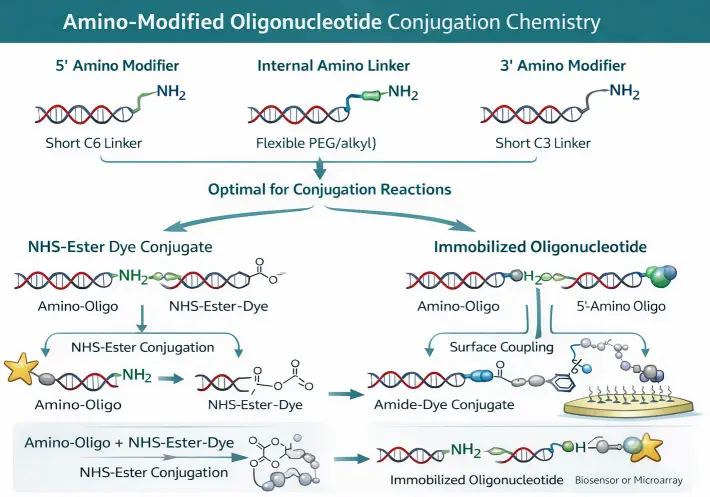
Amino-modified oligonucleotide architecture showing 5-prime, 3-prime, and internal amino modifications for dye labeling and conjugation

Amino-Modified Oligonucleotide Architecture. Representative terminal and internal amine installations used for post-synthetic labeling, surface coupling, and bioconjugation workflows.

Design insight: the optimal amino modifier depends on conjugation chemistry, desired position, linker length, steric accessibility, nucleic acid type, and the size of the intended labeling partner or immobilization surface.

Conjugation Chemistry with Amino-Modified Oligos

Common Amine-Reactive Chemistries

  • NHS ester coupling for fluorescent dyes and ligands
  • Isothiocyanate chemistry such as FITC labeling
  • EDC/NHS coupling to carboxyl-containing molecules
  • Activated surface immobilization on glass, beads, and sensor platforms

Why Amino Modifiers Are Useful

  • Broad compatibility with commercial labeling reagents
  • Flexible position control at terminal or internal sites
  • Wide range of linker lengths and spacer chemistries
  • Suitable for dyes, ligands, surfaces, polymers, and biomolecules

Common Amino Linkers Used in Oligonucleotide Synthesis

Amino C6 (Ahex)

The C6 amino linker is the most commonly used amine modification in oligonucleotide synthesis. The six-carbon spacer provides sufficient separation between the oligonucleotide backbone and attached dye or ligand, enabling efficient NHS ester coupling.

Amino C7

A slightly longer spacer arm than C6, providing improved accessibility when conjugating larger molecules such as antibodies, nanoparticles, or polymers.

Amino C12

Long hydrophobic spacer frequently used in surface immobilization applications where increased distance from the surface improves probe accessibility.

Available Amino-Modified Oligonucleotide Modifications

Each chemistry group below is collapsible so users can quickly scan the amino modifier family most relevant to their conjugation workflow.

Modification Category Position Options Description / Typical Use
5′-Amino Mod C3 Terminal linker 5′ Short terminal amino linker used for compact probe labeling and conjugation.
3′-Amino Mod C3 Terminal linker 3′ Short terminal amine for labeling or surface attachment when the 5′ end is reserved.
5′-Amino C6 (Ahex) Terminal linker 5′ Standard terminal amine linker widely used for NHS dye coupling and bioconjugation. Also commonly referred to as Ahex.
Amino Mod C6 (Ahex family) Terminal linker 5′ / 3′ depending on format General C6 amino linker category commonly used for dye and ligand attachment.
3′-Amino C7 Terminal linker 3′ Longer terminal linker providing improved accessibility.
5′-Amino C12 Terminal linker 5′ Long spacer arm used in immobilization and sterically crowded conjugation systems.
5′-Amino TEG Flexible linker 5′ Triethylene glycol spacer that improves flexibility and reduces steric hindrance.
5′-Amino C2 Short terminal linker 5′ Very short terminal amino linker used when minimal spacer length is desired.
3′-Amino C2 Short terminal linker 3′ Short 3′ amino linker for compact terminal conjugation.

Modification Category Position Options Description / Typical Use
Amino Mod C3 Internal Internal linker Internal Internal amine linker used for site-specific probe labeling and conjugation within the sequence.
Amino Modifier Serinol Internal linker Internal / terminal depending on design Flexible amino-containing spacer for improved accessibility in post-synthetic coupling.
Amino Spacer 7 C6 Internal Internal spacer Internal Extended internal amino spacer for positioning the amine away from the backbone.
Amino Spacer 7-C6 (3′) Spacer linker 3′ Extended 3′ amino spacer used for labeling or immobilization.
Internal Amino-TEG Flexible internal linker Internal Internal PEG-like amino spacer that improves accessibility in crowded systems.

Modification Category Position Options Description / Typical Use
2′-Amino-C Ribose-modified nucleoside Sequence position dependent 2′-amino cytidine analog used in modified nucleic acid architectures.
2′-Amino-U Ribose-modified nucleoside Sequence position dependent 2′-amino uridine analog for RNA-related modification strategies.
2,6-Diaminopurine (2-Amino dA) Purine analog Sequence position dependent Adenine analog with altered hydrogen-bonding and amino functionality.
2-Amino dA Purine analog Sequence position dependent Amino-containing adenine analog used in modified oligo design.
2-Amino Purine Deoxyribose Purine analog Sequence position dependent Deoxyribose version of 2-aminopurine used in modified DNA constructs.
2-Amino Purine Ribose Purine analog Sequence position dependent Ribose version of 2-aminopurine for RNA-related analog incorporation.
8-Amino-dA Purine analog Sequence position dependent Adenine derivative containing an amino substituent for specialized structural or functional studies.
8-Amino-dG Purine analog Sequence position dependent Guanine derivative with amino substitution for specialized modified oligos.

Modification Category Position Options Description / Typical Use
Amino Allyl Functional handle Format dependent General aminoallyl functionality used for post-synthetic dye labeling.
Aminoallyl dU Nucleobase-linked amine Internal / sequence position dependent Widely used for fluorescent labeling and probe functionalization.
Aminoallyl rU RNA nucleobase-linked amine Internal / sequence position dependent RNA version of aminoallyl uridine for post-synthetic conjugation.
Amino C6 U (RNA) RNA amino nucleoside Sequence position dependent RNA uridine containing a C6 amino linker for dye or ligand attachment.
5′-Amino dA Amino nucleoside 5′ Adenosine-linked terminal amino format for specialized oligo design.
Amino Deoxyadenosine dA C6 Amino nucleoside Sequence position dependent Deoxyadenosine analog with a C6 amino linker.
5′-Amino C6 dC Amino nucleoside 5′ Terminal cytidine-linked amino linker format.
3′-Amino C6 dC Amino nucleoside 3′ 3′ cytidine-linked amino handle for terminal conjugation.
Amino dC N4 PEG3 Amino Linker PEG-linked amino nucleoside Sequence position dependent Flexible PEG-containing amino dC format to improve accessibility and solubility.
5′-Amino C6 dG Amino nucleoside 5′ Terminal guanosine-linked amino handle.
3′-Amino C6 dG Amino nucleoside 3′ 3′ terminal guanosine-linked amino handle.
Amino C6 dG Amino nucleoside Sequence position dependent Guanine-linked amino functionality for internal or defined placement.
Amino C6 dT Amino nucleoside Sequence position dependent Thymidine-linked amino handle used in internal and site-specific labeling strategies.
5′-Amino C6 dT Amino nucleoside 5′ Terminal thymidine-linked amino modifier.
3′-Amino C6 dT Amino nucleoside 3′ 3′ terminal thymidine-linked amino modifier.

Modification Category Position Options Description / Typical Use
Aminooxy-Modifier-11 Specialized reactive handle Format dependent Aminooxy functionality used for oxime ligation with aldehyde- or ketone-containing partners.
PC Amino C6 (Photocleavable) Photocleavable linker Format dependent Photocleavable amino linker allowing light-triggered release after conjugation or capture.
AP-dC G-Clamp (Aminoethyl-Phenoxazine-dC) Specialized base analog Sequence position dependent Modified cytosine analog with aminoethyl-phenoxazine character used in specialized affinity or structural applications.

Typical Applications

Fluorescent Probe Labeling

Amino-modified oligos are widely used for NHS-ester dye coupling with fluorophores such as FITC, Cy dyes, Alexa dyes, and related probe labels.

Surface Immobilization

Amine handles support attachment to activated glass, beads, chips, microarrays, and biosensor surfaces for capture and analytical workflows.

Macromolecule Conjugation

Amino groups can be used to link oligos to peptides, proteins, antibodies, polymers, nanoparticles, and delivery components. Protein conjugation workflows can include oligo–antibody and other biomolecule-linked constructs.

Design Considerations

Linker Length Matters

Short linkers such as C2 or C3 minimize structural perturbation, while C6, C7, C12, TEG, and PEG-containing spacers improve accessibility when conjugating to larger dyes, proteins, polymers, or surfaces.

C2 / C3 compactC6 / C7 balancedC12 / TEG accessible

Choose Position Strategically

Terminal amino modifiers are ideal for directional conjugation, while internal amino handles enable site-specific labeling within the sequence. Internal nucleobase-linked amino modifiers are especially useful when probe geometry matters.

5′ directional3′ terminalInternal site-specific

Which Amino Linker Should You Choose?

Linker selection depends on the intended conjugation partner and how much spacing is needed between the oligonucleotide and the attached dye, surface, or biomolecule. Shorter amino linkers are often suitable for compact labeling, while longer or more flexible spacers can improve accessibility in surface-bound and macromolecular conjugates.

Guide for Selecting Amino Linkers
Use Case Recommended Amino Linker Reason
Standard dye conjugation Amino C6 (Ahex) Balanced spacer length for common NHS-based labeling workflows.
Improved accessibility Amino C7 Provides slightly greater reach than C6.
Surface immobilization Amino C12 Longer spacer can reduce steric crowding on solid supports.
Flexible internal labeling TEG-amino / Serinol Improves flexibility for internal conjugation and crowded systems.

Purification and Quality Control

Purification

Typical purification options include HPLC and PAGE depending on oligo length, modification type, and downstream application requirements.

Analytical Confirmation

Common QC methods include MALDI-TOF or LC-MS, analytical HPLC, UV quantification, and fit-for-purpose confirmation of the amino-modified product.

FAQ

What are amino-modified oligonucleotides used for?

They are widely used for dye labeling, surface immobilization, biosensors, nanoparticle attachment, and oligo conjugation to larger molecules.

Can amino modifiers be placed internally?

Yes. Internal amino installation is possible using internal linkers, aminoallyl nucleotides, amino-modified nucleobases, and related phosphoramidite chemistries.

What does aminoallyl mean in oligonucleotide synthesis?

Aminoallyl modifications provide a primary amine handle that is especially useful for post-synthetic dye conjugation and probe labeling.

What reagents react with amino-modified oligos?

NHS esters, isothiocyanates, activated carboxyl reagents, and related amine-reactive chemistries are commonly used.

Contact & Quote Request

For the fastest quote, share your oligonucleotide sequence, DNA or RNA type, desired amino modifier, modification position, synthesis scale, and purification requirements.

Quote checklist

  • Sequence and format
  • Amino modifier and position
  • DNA or RNA chemistry
  • Scale and purity target

Fastest path

  • Phone: +1-800-227-0627 | 1-972-420-8505

Recommended Reading

  1. Hermanson GT. Bioconjugate Techniques. Academic Press.
  2. Niemeyer CM. Semisynthetic DNA-Protein Conjugates for Biosensing and Nanotechnology.
  3. Gong H et al. Surface immobilization of DNA for biosensing applications.
  4. General literature covering amino-modified oligonucleotide labeling, NHS dye coupling, and surface immobilization strategies.

Why Choose Bio-Synthesis

Trusted by biotech leaders worldwide for over 45+ years of delivering high quality, fast and scalable synthetic biology solutions.