Header

Header

Header

Antibody Nanoparticle Conjugation Services

Custom antibody nanoparticle conjugation and nanoparticle bioconjugation for gold nanoparticles, magnetic particles, quantum dots, silica nanoparticles, and polymer nanoparticles. Antibody-functionalized nanoparticle conjugates are designed for diagnostics, biosensing, imaging, capture and separation, and targeted delivery applications.

gold nanoparticles magnetic particles quantum dots polymer nanoparticles imaging & detection biosensors targeted delivery

Overview

Antibody nanoparticle conjugation combines the molecular specificity of antibodies with the functional properties of nanoparticles to create advanced materials for detection, imaging, capture, separation, and targeted delivery. Through custom nanoparticle conjugation and antibody labeling of nanoparticles, the final conjugate can be tailored for optical readout, magnetic handling, fluorescent signaling, biosensing, or delivery-oriented workflows.
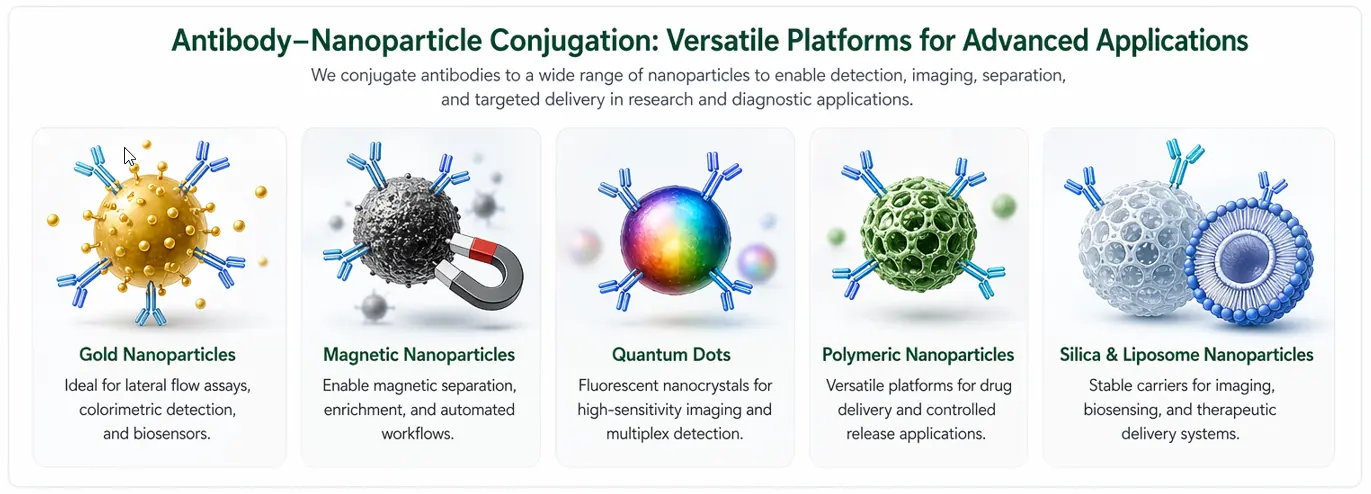
Antibody nanoparticle conjugation collage showing gold nanoparticles, magnetic particles, quantum dots, polymer nanoparticles, and antibody targeting applications
Antibody–nanoparticle conjugates can be configured for diagnostics, imaging, biosensing, separation, and delivery systems.

Different nanoparticle systems bring different functional advantages. Gold nanoparticles support colorimetric detection and lateral flow systems, magnetic particles enable separation and enrichment, quantum dots provide fluorescent imaging capability, and polymer or silica nanoparticles can be used for engineered delivery and surface-functionalized analytical workflows.

Built around the final application: The best nanoparticle conjugation strategy depends on particle type, surface chemistry, antibody format, stability requirements, signal readout, and whether the goal is detection, separation, imaging, or delivery.

Platforms

Optical to magnetic

Support for gold, magnetic, fluorescent, silica, and polymer nanoparticle systems

Formats

IgG, IgM, and fragments

Whole antibodies, IgG, IgM, fragments, and secondary probe formats can be supported

Use Cases

Detection to delivery

Useful for diagnostics, biosensing, capture, enrichment, imaging, and targeted delivery

Approach

Application-specific

Conjugation strategy aligned to nanoparticle surface chemistry and intended performance

What We Can Conjugate to Nanoparticles

Antibody nanoparticle conjugation can be applied to multiple antibody and probe formats depending on the intended assay design, imaging method, particle system, and downstream workflow.

Whole Antibodies

Antibody–nanoparticle conjugation of full-length antibodies for diagnostics, biosensing, targeting, separation, and analytical workflows.

IgG Antibodies

Nanoparticle conjugation of IgG antibodies for routine immunoassays, imaging, magnetic separation, and targeted particle systems.

IgM Antibodies

Support for IgM conjugation when this antibody class is required for the final analytical or targeting workflow.

Antibody Fragments

Conjugation of Fab, F(ab')2, and related fragment formats for reduced steric hindrance, altered Fc behavior, or particle surface optimization.

Primary Antibodies

Particle conjugation of primary antibodies for direct target recognition in detection, imaging, and targeted delivery systems.

Secondary Detection Probes

Nanoparticle-conjugated secondary reagents for indirect detection, signal amplification, and specialized assay architecture.

One service, multiple compatible formats: These are not separate services. They are the antibody and probe formats that can be used within the broader antibody nanoparticle conjugation service.

Nanoparticle Systems

Gold Nanoparticles

Widely used in lateral flow assays, colorimetric detection, biosensors, and analytical systems that benefit from strong optical properties.

Magnetic Nanoparticles

Support magnetic separation, capture, enrichment, sample handling, and automation workflows in assay and diagnostic systems.

Quantum Dots

Fluorescent nanoparticle systems used for multiplex imaging, long-lived signal generation, and sensitive optical detection workflows.

Silica Nanoparticles

Stable surface-functionalizable particles used in analytical platforms, biosensing, and imaging-related applications.

Polymer Nanoparticles

Useful for delivery systems, encapsulation strategies, engineered surface presentation, and targeted biological applications.

Project-Specific Particle Systems

Conjugation strategy can be aligned to specialized or custom particle formats depending on the final use case and surface chemistry.

Conjugation Chemistry

We select the optimal chemistry based on nanoparticle type, antibody format, application requirements, and the desired performance of the final nanoparticle antibody conjugate.

Adsorption chemistry for gold nanoparticle antibody conjugation

Adsorption (Gold NP)

Passive adsorption via electrostatic and hydrophobic interactions for gold nanoparticles.

Covalent coupling EDC NHS chemistry for antibody conjugation

Covalent Coupling (EDC/NHS)

Stable amide bond formation for strong and reliable antibody conjugation.

Click chemistry for antibody nanoparticle conjugation

Click Chemistry

Bioorthogonal conjugation for precise orientation and high efficiency.

Crosslinkers and linkers for antibody nanoparticle conjugation

Crosslinkers & Linkers

A variety of linkers for controlled spacing and improved functionality.

Why chemistry matters: Conjugation chemistry affects particle stability, antibody orientation, binding activity, surface accessibility, signal performance, and the final behavior of the conjugate in the intended system.

What’s Included in Antibody Nanoparticle Conjugation Services

Nanoparticle Selection

gold / magnetic / Qdotapplication fit

Select the most suitable particle system based on optical, magnetic, fluorescent, separation, or delivery requirements.

Surface Chemistry Strategy

adsorptioncovalent attachment

Align the conjugation approach to the particle surface, antibody format, stability needs, and downstream assay or delivery behavior.

Application-Focused Design

diagnosticstargeting

Support antibody–nanoparticle design around the final application rather than a generic particle-labeling workflow.

Signal and Functional Planning

optical / magneticdelivery

Match the particle platform to the required optical signal, magnetic handling, surface presentation, or delivery function.

Stability and Format Review

surface behaviorparticle performance

Consider conjugate stability, antibody compatibility, and particle behavior under the intended experimental or analytical conditions.

Custom Project Configuration

custom requestspecialized platform

Support project-specific nanoparticle conjugation needs where particle system, targeting design, signal requirements, or platform integration define the workflow.

Typical Applications

Common applications for antibody nanoparticle conjugates include lateral flow assays, biosensors, magnetic separation, fluorescence imaging, targeted delivery, and diagnostic assay development.

Lateral Flow Assays

Gold nanoparticle antibody conjugates are widely used for visible detection in rapid assay formats.

Biosensors

Nanoparticle conjugates can enhance sensitivity and surface recognition in biosensor platforms.

Imaging

Quantum dots and related fluorescent nanoparticles support optical imaging and multiplex detection workflows.

Magnetic Separation

Magnetic particle conjugates support capture, enrichment, purification, and target isolation workflows.

Targeted Delivery

Antibody-functionalized particle systems can be used in targeting strategies for delivery-oriented applications, with performance influenced by particle chemistry and surface design.

Diagnostic Development

Nanoparticle antibody conjugates are useful in assay development, platform engineering, and diagnostic system design.

Typical Project Workflow

Typical project workflow for antibody nanoparticle conjugation including nanoparticle selection, antibody compatibility review, conjugation strategy, and delivery

Typical Deliverables

Nanoparticle-Conjugated Reagent

  • Prepared antibody–nanoparticle conjugate according to project scope and selected particle system
  • Material suitable for diagnostic, analytical, imaging, separation, or delivery-related workflows

Project Documentation

  • Summary of particle system, conjugation approach, and reagent format
  • Applicable project details or QC information depending on service scope

Why Choose Us?

  • Broad experience with multiple nanoparticle platforms
  • Application-focused conjugation strategy
  • Attention to conjugate stability and antibody performance
  • Support for analytical and delivery-oriented projects

Quality You Can Trust

  • Project-specific conjugation design
  • Review of particle system and antibody format compatibility
  • Workflow aligned to the intended platform
  • Documentation provided according to scope

Ready to Get Started?

Tell us about your nanoparticle type, antibody format, and final application. We’ll help match the project to the right conjugation strategy.

FAQ

Which nanoparticle types can be used?

Common systems include gold nanoparticles, magnetic particles, quantum dots, silica nanoparticles, polymer nanoparticles, and related engineered particle formats.

Which antibody formats can be conjugated to nanoparticles?

Whole antibodies, IgG, IgM, antibody fragments such as Fab or F(ab')2, primary antibodies, and secondary detection probes can all be used depending on project needs.

What are common applications of antibody nanoparticle conjugates?

Typical uses include lateral flow assays, imaging, biosensors, magnetic separation, capture assays, diagnostics, cell targeting, and targeted delivery systems.

What is antibody nanoparticle conjugation?

It is the attachment of antibodies or antibody fragments to nanoparticle systems so the final conjugate can be used for detection, imaging, capture, separation, biosensing, or delivery-related applications.

How are antibodies attached to nanoparticles?

Attachment may use passive adsorption, covalent coupling, thiol-based methods, affinity-mediated approaches, or surface-functionalized chemistry depending on the particle system.

Why use antibody nanoparticle conjugation?

This approach combines antibody specificity with the optical, magnetic, fluorescent, or delivery properties of nanoparticles to create highly functional materials for advanced analytical and biomedical workflows.

Contact & Quote Request

For the fastest quote, include the nanoparticle type, antibody format, intended application, desired readout or functionality, and whether the project is focused on detection, separation, imaging, or targeted delivery.

Helpful details to include

  • Gold, magnetic, quantum dot, silica, polymer, or other nanoparticle system
  • Whole antibody, IgG, IgM, fragment, or secondary probe format
  • Detection, biosensing, capture, imaging, separation, or delivery objective
  • Key platform or stability requirements for the final conjugate

Fastest path

Why Choose Bio-Synthesis

Trusted by biotech leaders worldwide for over 45+ years of delivering high quality, fast and scalable synthetic biology solutions.