Click-Ready Oligonucleotides

Custom bioorthogonal oligo modifications for CuAAC, SPAAC, and related click conjugation workflows.

Click-ready oligos with azide, alkyne, 5′-Hexynyl, Octadiynyl-dU, DBCO-NHS ester, DBCO-TEG, and related handles for post-synthetic conjugation to dyes, peptides, proteins, polymers, nanoparticles, and therapeutic delivery systems.

Azide / alkyne / DBCO handles 5′ / 3′ / internal options CuAAC and SPAAC compatible DNA & RNA compatible Probe and conjugate ready

Overview

Click-ready oligonucleotides are synthetic DNA or RNA molecules engineered with reactive chemical handles that support highly selective post-synthetic conjugation through bioorthogonal click chemistry...

Click chemistry is widely used for post-synthetic oligonucleotide conjugation because it is highly selective, compatible with aqueous conditions, and can form stable triazole-linked products under mild reaction conditions [1].

Common click-compatible handles include azide, alkyne, 5′-Hexynyl, Octadiynyl-dU, DBCO, and related strained alkyne systems...
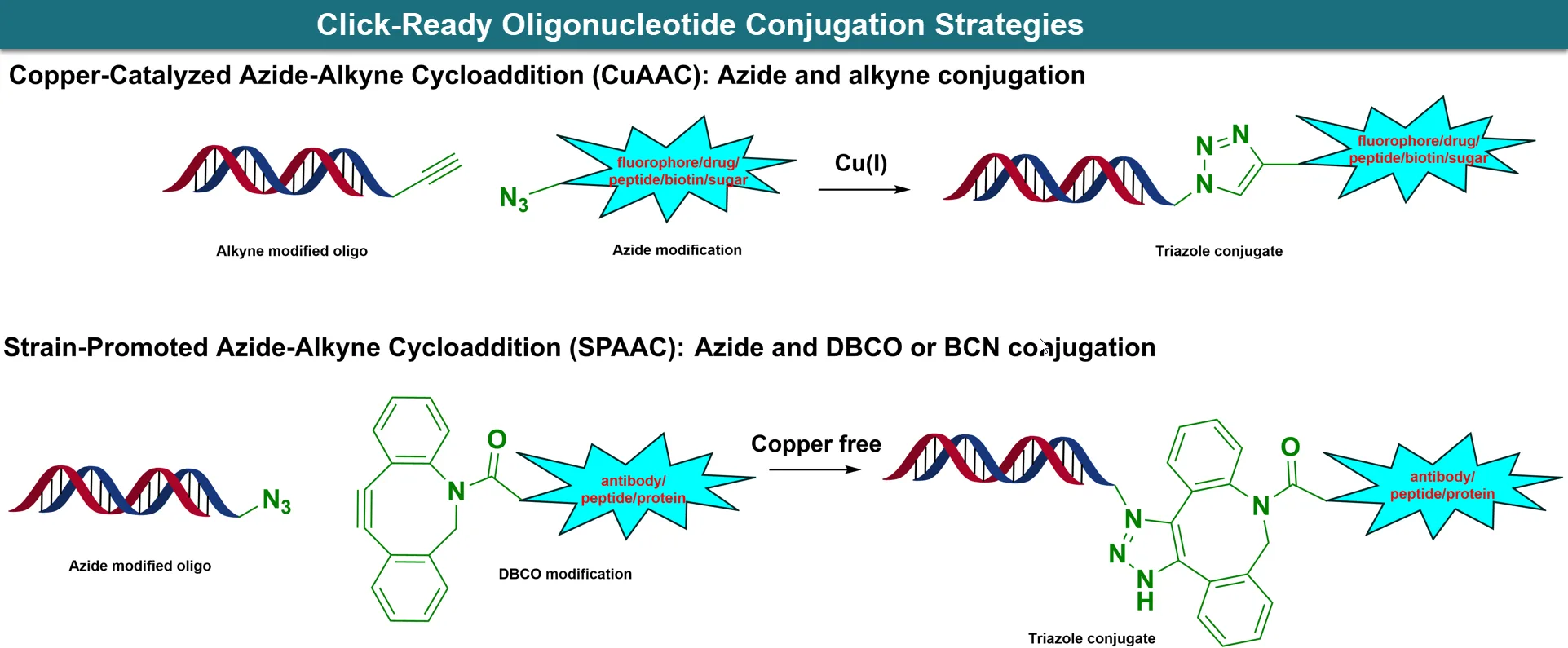
Click-Ready Oligonucleotide Conjugation Architecture.</strong> Representative azide, alkyne, 5′-Hexynyl, Octadiynyl-dU, and DBCO-based oligo

Click-Ready Oligonucleotide Conjugation Architecture. Representative azide, alkyne, 5′-Hexynyl, Octadiynyl-dU, and DBCO-based oligo handles used for CuAAC and copper-free SPAAC conjugation to fluorophores, peptides, proteins, polymers, and nanoparticles.

Why Click Chemistry Is Useful for Oligonucleotide Conjugation
  • Compatible with aqueous reaction conditions
  • Often performed at room temperature
  • Highly selective with minimal side reactions
  • Limited interference from other functional groups
  • Forms stable triazole-linked conjugates in CuAAC workflows
Design insight: the best click-ready oligo format depends on the reactive partner, tolerance for copper catalysis, desired conjugation position, steric accessibility, purification requirements, and intended downstream biological application.

Click Chemistry Platforms for Oligonucleotide Conjugation

CuAAC

Classical copper-catalyzed azide-alkyne cycloaddition between azide and terminal alkyne groups. Useful for stable triazole-linked conjugates in probe, dye, and polymer labeling workflows.

SPAAC

Copper-free strain-promoted azide-alkyne cycloaddition using strained alkynes such as DBCO. Favored for biological systems, sensitive payloads, and conjugations where copper is undesirable.

Other Bioorthogonal Ligation

Advanced ligation systems such as tetrazine–TCO can be considered in specialized platforms that require very rapid kinetics and highly selective conjugation.

Click Reaction Compatibility Matrix

Different click chemistry systems offer distinct advantages depending on reaction environment, biological compatibility, and conjugation partner. The matrix below summarizes commonly used bioorthogonal ligation strategies for click-modified oligonucleotides.

Common Click Chemistry Reactions for Oligonucleotide Conjugation
Reaction Type Reactive Handles Catalyst Requirement Advantages Typical Applications
CuAAC Azide + Terminal Alkyne Copper (Cu(I)) High efficiency and reliable triazole linkage formation. Fluorophore labeling, probe synthesis, polymer–oligo conjugation, DNA nanotechnology.
SPAAC Azide + DBCO / BCN None (copper-free) Biocompatible reaction suitable for biological systems and sensitive biomolecules. Antibody–oligo conjugates, nanoparticle attachment, in-cell labeling, therapeutic oligo conjugation.
IEDDA Tetrazine + TCO None Extremely fast reaction kinetics with high selectivity. Advanced imaging, rapid labeling systems, bioorthogonal ligation platforms.

CuAAC and related bioorthogonal click reactions are widely used for nucleic acid conjugation due to their high selectivity, efficiency, and compatibility with aqueous biological environments [1–4].

Click Handle Selection Guide

Selecting the appropriate click handle depends on the intended conjugation partner, reaction conditions, and biological compatibility requirements. The guide below summarizes commonly used click-ready oligonucleotide modifications and their preferred applications.

Guide for Selecting Click-Compatible Oligonucleotide Handles
Click Handle Reaction Partner Advantages Recommended Use
Azide Alkyne / DBCO Small modification with minimal structural impact on the oligonucleotide. General click conjugation with fluorophores, peptides, nanoparticles, and macromolecules.
5′-Hexynyl Azide Terminal alkyne modification that supports efficient CuAAC conjugation. Dye labeling, probe development, and polymer conjugation.
Octadiynyl-dU Azide Internal or terminal alkyne-bearing nucleobase allowing site-specific conjugation within an oligonucleotide sequence. DNA nanotechnology, structural probes, and internally labeled constructs.
DBCO Azide Strained cyclooctyne enabling copper-free SPAAC click chemistry. Conjugation to proteins, antibodies, nanoparticles, or sensitive biomolecules.
DBCO-TEG Azide Flexible spacer improves accessibility and reduces steric hindrance. Conjugation to large biomolecules such as antibodies and polymers.

Bioorthogonal click reactions such as CuAAC and SPAAC provide efficient methods for attaching functional molecules to oligonucleotides with high selectivity and minimal interference with nucleic acid hybridization [1–4].

Available Click-Ready Oligonucleotide Modifications

Click-compatible functional groups can be introduced directly during solid-phase oligonucleotide synthesis using specialized phosphoramidite reagents or installed post-synthetically through reactive handles such as NHS esters. These modifications enable highly selective conjugation using CuAAC, SPAAC, and related bioorthogonal click reactions [1–4].

Modification Click Handle Type Placement Options Description
Alkyne-Modified Nucleotides (CuAAC Compatible)
5′-Hexynyl Terminal Alkyne 5′ Introduces a terminal alkyne handle for copper-catalyzed azide-alkyne cycloaddition (CuAAC) reactions with azide-modified dyes, peptides, or polymers.
Octadiynyl-dU Internal Alkyne Nucleobase 5′ / 3′ / internal Uridine analog containing a di-alkyne moiety that enables site-specific click conjugation within oligonucleotide sequences.
C8-Alkyne-dC Amidite Internal Alkyne Nucleobase 5′ / 3′ / internal Cytidine phosphoramidite bearing an alkyne group at the C8 position, allowing internal installation of click-reactive handles during synthesis.
5-Ethynyl-dU Amidite Alkyne Nucleobase 5′ / 3′ / internal Ethynyl-modified uridine building block providing a compact alkyne handle for click conjugation while maintaining minimal structural perturbation to the oligonucleotide.
TIPS-5-Ethynyl-dU Amidite Protected Alkyne 5′ / 3′ / internal Triisopropylsilyl-protected ethynyl nucleoside used during synthesis to improve stability of alkyne functionality prior to deprotection.
Azide-Modified Oligonucleotides
5′-Azide Azide 5′ Small azide modification compatible with CuAAC or copper-free SPAAC click reactions.
3′-Azide Azide 3′ Terminal azide used for conjugation with alkyne- or DBCO-modified molecules.
Internal Azide Azide internal Azide handle inserted within the oligonucleotide backbone for site-specific click labeling.
Strained Alkyne (Copper-Free SPAAC)
DBCO NHS Ester Strained Alkyne 5′ / 3′ / internal (via amino handle) DBCO installed through NHS ester coupling to amino-modified oligonucleotides, enabling copper-free SPAAC click conjugation.
DBCO-TEG Strained Alkyne 5′ / 3′ / internal DBCO modification with triethylene glycol spacer that improves accessibility and reduces steric hindrance in macromolecular conjugation.
DBCO-dT Amidite Strained Alkyne Nucleobase 5′ / 3′ / internal Thymidine analog bearing a DBCO group that allows direct installation of SPAAC-compatible click handles during oligonucleotide synthesis.
Click Reaction Catalysts and Reagents
THPTA Ligand CuAAC Catalyst Stabilizer Reaction Reagent Tris(hydroxypropyltriazolylmethyl)amine (THPTA) ligand stabilizes Cu(I) during CuAAC click reactions and improves reaction efficiency while reducing oxidative damage to nucleic acids.

Click chemistry provides highly selective bioorthogonal conjugation strategies widely used for oligonucleotide labeling, probe construction, and macromolecular conjugation workflows [1–4].

Conjugation Positions on Oligonucleotides

5′ Click Modification

Common for terminal conjugation of dyes, ligands, peptides, proteins, and delivery elements where directional attachment is preferred.

3′ Click Modification

Useful when the 5′ end is reserved for another function or when conjugation orientation must be reversed for assay design.

Internal Click Modification

Allows installation of reactive handles within the oligonucleotide sequence, useful for structural probes, nanotechnology, and specialized functional architectures.

Applications of Click-Ready Oligos

Molecular Diagnostics

Post-synthetic fluorescent probe labeling, hybridization probe functionalization, and biosensor builds.

Therapeutic Conjugates

Attachment of ligands, lipids, polymers, or targeting molecules to antisense oligonucleotides, siRNA, and related therapeutic oligos.

Nanotechnology

DNA nanostructures, programmable assemblies, and surface-linked oligonucleotide materials.

Imaging and Tracking

Bioorthogonal attachment of fluorophores and reporters for cellular imaging and molecular tracking workflows.

Antibody–Oligo Conjugates

Site-selective conjugation strategies for multiplex proteomics, spatial biology, and detection platforms.

Polymer and Nanoparticle Attachment

Oligo conjugation to PEG, synthetic polymers, nanoparticles, and other material science platforms.

Design Considerations for Click-Ready Oligonucleotides

Alkyne-Modified Oligonucleotides

Alkyne modifications such as 5′-Hexynyl and Octadiynyl-dU provide efficient click-reactive handles for CuAAC with azide-containing molecules. These are useful for fluorophore labeling, polymer conjugation, probe development, and DNA nanostructure assembly.

CuAAC-compatible Stable triazole linkages Site-specific labeling
DBCO-Modified Oligonucleotides

DBCO modifications such as DBCO-NHS Ester and DBCO-TEG enable copper-free SPAAC reactions with azide-modified partners. This is often preferred in biological systems where copper exposure may be undesirable or incompatible with sensitive biomolecules.

Copper-free SPAAC Biologically compatible Flexible spacer options
Selection Guide
  • Use alkyne or 5′-Hexynyl when CuAAC is acceptable and high click efficiency is desired.
  • Use DBCO or DBCO-TEG when copper-free SPAAC is needed for biological compatibility.
  • Use Octadiynyl-dU when an internal or dual-position alkyne architecture is needed.
  • Consider linker length and steric accessibility when conjugating to proteins, antibodies, nanoparticles, or polymers.

Purification and Quality Control

Purification

Click-ready oligonucleotides are typically purified using chromatographic methods appropriate for the modification and oligo architecture to ensure conjugation-ready purity.

Analytical Confirmation

Typical analytical methods may include HPLC, LC-MS or MALDI-TOF, UV measurement, and additional fit-for-purpose confirmation depending on the project requirements.

FAQ

What are click-ready oligonucleotides?

They are DNA or RNA oligos containing reactive handles such as azide, alkyne, or DBCO that allow post-synthetic bioorthogonal conjugation.

What is the difference between CuAAC and SPAAC?

CuAAC uses copper catalysis with azide and terminal alkyne groups, while SPAAC is copper-free and typically uses strained alkynes such as DBCO with azides.

Can click handles be installed internally?

Yes. Certain handles such as Octadiynyl-dU, azide, and some DBCO-compatible routes can be used internally depending on chemistry and design requirements.

Which click chemistry is best for biological systems?

Copper-free SPAAC systems using azide and DBCO are often preferred when biological compatibility and avoidance of copper are important.

Contact & Quote Request

For the fastest quote, share your oligonucleotide sequence, oligo type, desired click handle, placement position, intended click partner, synthesis scale, and purity requirements.

Quote checklist
  • Sequence and format
  • Reactive handle and position
  • CuAAC or SPAAC preference
  • Scale and purity target
Fastest path
  • Phone: +1-800-227-0627 | 1-972-420-8505
  • Web: biosyn.com/contactus

Recommended Reading

  1. Kolb HC, Finn MG, Sharpless KB. Click Chemistry: Diverse Chemical Function from a Few Good Reactions. Angew Chem Int Ed. 2001.
  2. Rostovtsev VV, Green LG, Fokin VV, Sharpless KB. A Stepwise Huisgen Cycloaddition Process: Copper(I)-Catalyzed Regioselective Ligation of Azides and Terminal Alkynes. Angew Chem Int Ed. 2002.
  3. Agard NJ, Prescher JA, Bertozzi CR. A strain-promoted [3 + 2] azide-alkyne cycloaddition for covalent modification of biomolecules in living systems. J Am Chem Soc. 2004.
  4. Sletten EM, Bertozzi CR. Bioorthogonal Chemistry: Fishing for Selectivity in a Sea of Functionality. Angew Chem Int Ed. 2009.
  5. Hermanson GT. Bioconjugate Techniques. Academic Press.

Why Choose Bio-Synthesis

Trusted by biotech leaders worldwide for over 45+ years of delivering high quality, fast and scalable synthetic biology solutions.