Functionalized oligonucleotides are chemically modified DNA or RNA molecules designed to introduce specific labels, affinity tags, reactive handles, or crosslinking groups. These modifications allow oligos to do more than hybridize to a complementary sequence; they can report signal, bind surfaces, capture targets, link to biomolecules, or participate in controlled conjugation reactions.
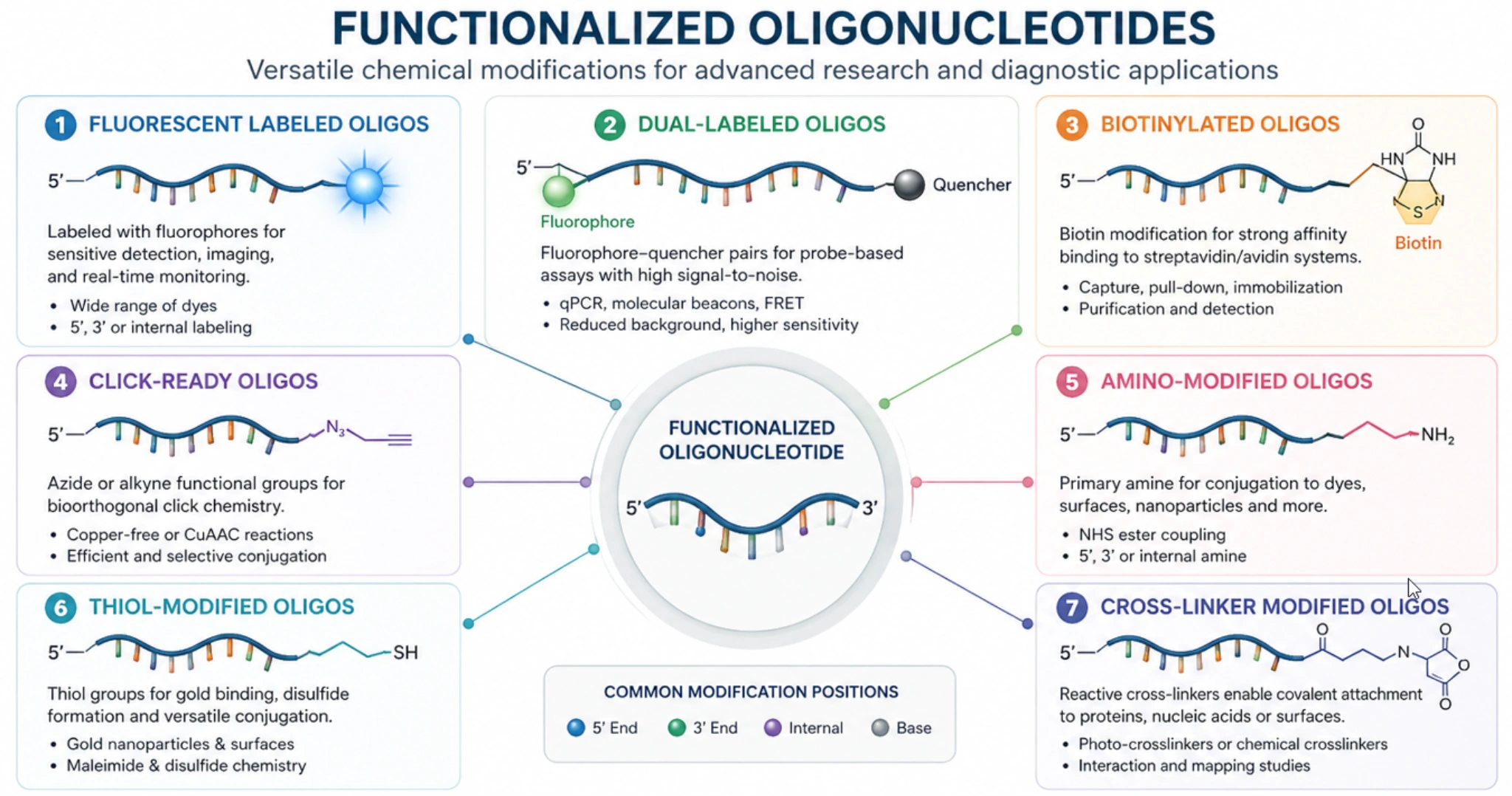
Overview of functionalized oligonucleotide modifications including fluorescent labels, biotin, click chemistry, amino, thiol, and cross-linker functional groups.
Bio-Synthesis supports a broad range of functionalized oligo synthesis options, including fluorescent labeled oligos, dual-labeled oligos, biotinylated oligos, click-ready oligos, amino-modified oligos, thiol-modified oligos, and cross-linker modified oligos.
These oligos are commonly used in qPCR probes, FISH, molecular beacons, pull-down assays, streptavidin capture, nanoparticle attachment, biosensor design, surface immobilization, targeted conjugation, interaction studies, and diagnostic assay development.
What is a functionalized oligonucleotide?
A functionalized oligonucleotide is a DNA or RNA oligo modified with a chemical group that provides a specific function such as fluorescence, affinity capture, covalent coupling, surface attachment, click chemistry reactivity, or crosslinking.
Functional oligo design platform
Label • Capture • Conjugate
Functionalized oligos convert sequence-specific recognition into measurable signal, affinity capture, molecular attachment, or downstream conjugation.
Detection
Fluorescent
Reporter dyes for imaging, qPCR, probes, and hybridization assays
Affinity
Biotin
Streptavidin capture, immobilization, and purification systems
Conjugation
Amine / Thiol
Reactive handles for coupling to dyes, proteins, surfaces, and particles
Custom
Available
Support for special linkers, spacers, crosslinkers, and project-specific formats