Therapeutic Oligo Bioconjugation

Bio-Synthesis offers advanced bioconjugation strategies for siRNA, ASO, SSO, aptamers, and related therapeutic oligonucleotide platforms to improve targeting, delivery, stability, and pharmacological performance.

GalNAc lipid conjugates peptide conjugates antibody-oligo polymer conjugates cleavable linkers 5′ / 3′ / internal functionalization delivery optimization

Overview

Bio-Synthesis provides advanced therapeutic oligonucleotide bioconjugation services to support targeted delivery, improved stability, and optimized pharmacological performance of oligo-based therapeutics. Our capabilities span siRNA, antisense oligonucleotides (ASO), splice-switching oligos (SSO), and aptamers for programs requiring both design flexibility and technical rigor.

We design and produce customized oligonucleotide conjugates by integrating ligands, lipids, peptides, antibodies, and polymers with carefully selected linker chemistries and site-specific functionalization strategies. These approaches help improve biodistribution, receptor-mediated uptake, intracellular delivery, and overall developability.

Our team works closely with researchers to optimize conjugation strategy, linker design, and attachment position (5′, 3′, or internal), ensuring each construct is aligned with the intended biological mechanism and development stage—from early discovery through preclinical evaluation.
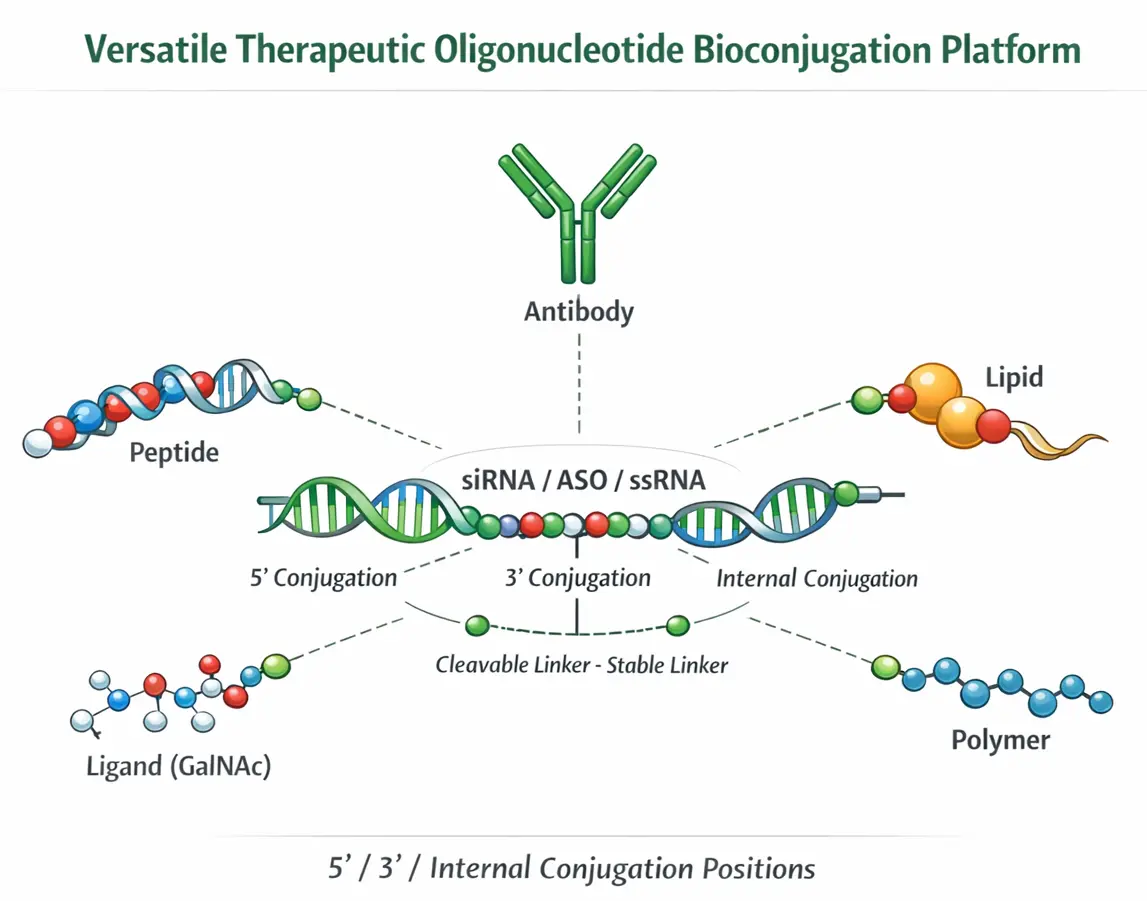
GalNAc uptake, antibody-oligonucleotide conjugate, and linker release illustrations for therapeutic oligo bioconjugation
Therapeutic Oligo Bioconjugation Concepts. Representative illustrations highlight receptor-mediated uptake, targeted antibody-oligonucleotide delivery, and linker-enabled release strategies used to improve therapeutic performance.
Why it matters: Effective bioconjugation is a critical component of oligonucleotide drug development, enabling targeted delivery, controlled release, and improved in vivo performance across therapeutic programs.

Platform Scope

siRNA • ASO • SSO • Aptamers

Broad therapeutic oligo compatibility

Conjugate Classes

Ligand • Lipid • Peptide • Antibody • Polymer

Flexible conjugation strategies

Design Control

Linker • Position • Architecture

Precise functional optimization

Program Support

Discovery → Preclinical

End-to-end project support

Conjugation Modalities and Enabling Strategies

Ligand–Oligonucleotide Conjugates

Ligand attachment supports receptor-guided delivery strategies, including GalNAc-style architectures and related targeting concepts for tissue-selective uptake.

  • Receptor-mediated delivery design
  • Tissue-focused targeting concepts
  • Useful for siRNA and ASO platforms

Lipid-Conjugated Oligonucleotides

Lipid and hydrophobic modifications can enhance membrane interaction, alter biodistribution, and support serum-associated transport behavior.

  • Cholesterol and fatty-acid style concepts
  • Uptake-supporting architectures
  • PK and exposure tuning

Peptide–Oligonucleotide Conjugates

Peptide attachment provides flexible routes for cell penetration, targeting, and intracellular trafficking enhancement.

  • CPP-inspired strategies
  • Targeting peptide concepts
  • Delivery-oriented design flexibility

Antibody–Oligonucleotide Conjugates

Antibody-guided constructs support high-specificity targeting where selectivity and controlled tissue engagement are central to the design goal.

  • Target-guided delivery concept
  • Advanced selective architecture
  • Useful for precision programs

Polymer–Oligonucleotide Conjugates

Polymer attachments can improve pharmacokinetics, reduce rapid clearance, and support controlled or responsive release strategies.

  • PEG-like and smart-polymer concepts
  • Exposure and circulation management
  • Release-enabled design possibilities

Multivalent & Scaffold-Based Systems

Scaffold-driven assemblies create opportunities for avidity, modularity, and functional amplification in advanced oligonucleotide platforms.

  • Multicomponent display strategies
  • Modular architecture design
  • Useful for advanced delivery engineering

Program Workflow

A typical therapeutic oligonucleotide bioconjugation program progresses through a structured workflow from target definition to conjugate design and preclinical advancement.

Program workflow for therapeutic oligo bioconjugation showing define goal, select class, configure design, and advance program
Program Workflow. A typical therapeutic oligo bioconjugation program progresses from defining the biological goal, selecting the oligonucleotide class and payload position, configuring linker and chemistry design, and advancing the construct through characterization and preclinical evaluation.

Conjugation Strategy Comparison

This comparison table helps distinguish major therapeutic bioconjugation strategies by design purpose and development focus.

Conjugate class Primary purpose Typical design value Representative considerations
Ligand conjugates Receptor-mediated targeting Tissue selectivity and uptake Receptor density, valency, attachment geometry
Lipid conjugates Distribution and membrane interaction Improved uptake and PK tuning Hydrophobicity balance, aggregation, serum behavior
Peptide conjugates Cell access and trafficking Intracellular delivery enhancement Sequence liability, charge, endosomal behavior
Antibody conjugates High-specificity targeting Selective delivery concept Stoichiometry, site control, macromolecule compatibility
Polymer conjugates Pharmacokinetic modification Half-life and clearance optimization Polydispersity, release strategy, steric effects
Multivalent systems Modular architecture and avidity Functional amplification potential Assembly reproducibility, loading, structural consistency

Design Considerations

Oligo Modality Fit

The optimal conjugation strategy depends on whether the construct is a siRNA, ASO, SSO, aptamer, or another therapeutic oligonucleotide format and how the intended mechanism must be preserved.

Attachment Position

Placement at the 5′ end, 3′ end, or internal positions can influence potency, binding, duplex performance, manufacturability, and analytical simplicity.

Linker Behavior

Stable, cleavable, and responsive linkers should be chosen according to the target tissue, biological pathway, and intended release objective.

Manufacturability

Conjugates should be designed with realistic synthesis, purification, and characterization workflows in mind to support program scale-up and reproducibility.

Analytical Readiness

Complex conjugates require clear identity and purity confirmation, often using orthogonal methods to resolve the final architecture with confidence.

Developability

Successful constructs balance targeting, potency, stability, tolerability, and production feasibility rather than over-optimizing only one parameter.

Why Bio-Synthesis

Integrated Design Support

Bio-Synthesis supports projects from early concept through preclinical development with practical guidance on conjugate class selection, linker logic, and attachment strategy.

Flexible Conjugation Options

We support a broad range of oligonucleotide modalities and conjugation concepts, enabling researchers to align chemistry design with therapeutic mechanism and delivery goals.

Execution with Analytical Rigor

Our workflows are built around clear technical communication, project-specific design requirements, and the analytical rigor needed for advanced oligonucleotide conjugation programs.

Why This Matters

Clarifies Strategy

A focused page helps teams understand how conjugation enables targeting, uptake, and pharmacological performance instead of treating it as a minor add-on chemistry step.

Supports Internal Linking

This page can naturally connect to siRNA, ASO, SSO, aptamer, formulation, and analytical pages without overloading the overview itself.

Improves Program Readiness

Bringing targeting, linker, and architecture considerations into one hub makes the page more useful for technical planning and commercial qualification.

FAQ

What is therapeutic oligo bioconjugation?

Therapeutic oligo bioconjugation is the attachment of ligands, lipids, peptides, antibodies, polymers, or other functional groups to oligonucleotides to improve delivery, targeting, stability, and pharmacological performance.

Do conjugates affect oligonucleotide activity?

Yes. Conjugation chemistry, linker design, payload identity, and attachment position can all influence uptake, potency, and overall developability.

Which oligonucleotide types can be conjugated?

Common therapeutic formats include siRNA, antisense oligonucleotides, splice-switching oligonucleotides, aptamers, and other modified oligonucleotide architectures depending on development goals.

What conjugation positions are commonly used?

Conjugation can be introduced at the 5′ end, 3′ end, or internal positions depending on sequence, mechanism, payload, and design constraints.

Why are linker chemistries important?

Linkers influence stability, release profile, manufacturability, and biological performance. Stable, cleavable, and responsive strategies each support different therapeutic objectives.

What information helps with quoting?

The fastest quote usually includes the oligo type, target tissue or delivery objective, desired conjugate class, preferred linker strategy, scale, and analytical requirements.

Contact & Quote Request

For the fastest response, please provide your oligonucleotide type, delivery objective, desired conjugation strategy, linker preferences, and project stage.

What to include

  • Oligo class and target tissue or mechanism
  • Desired conjugate type or linker preference
  • Scale and purity expectations
  • Research, translational, or preclinical stage

Fastest path

Why Choose Bio-Synthesis

Trusted by biotech leaders worldwide for over 45+ years of delivering high quality, fast and scalable synthetic biology solutions.